

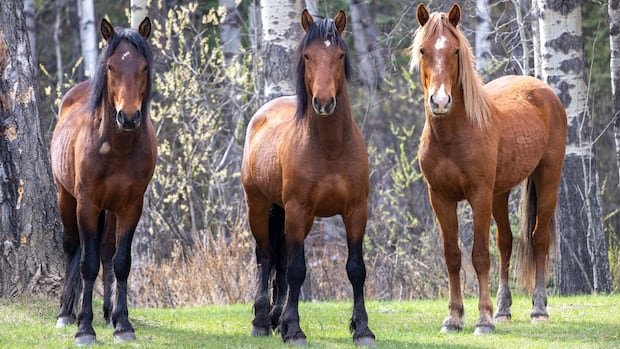

Health Canada has granted approval for the testing of a birth control vaccine on free-roaming horses in Alberta. The Alberta government deems it necessary to control horse populations in certain areas of the province to prevent them from adversely impacting grazing lands for cattle and wildlife.
One of the strategies outlined in the province’s feral horse management framework is contraception, along with removal from the wild and adoption. Health Canada confirmed that the Alberta government received a “research authorization” for the use of the SpayVac-Equid contraception vaccine in late August. This authorization allows studying the product in feral horses but does not constitute general approval for its use.
The province is currently reviewing the approval details related to horse contraception and is working with stakeholders to implement management actions in a humane and science-based manner. The latest feral horse survey in Alberta identified a record high of 2,072 wild horses in the six equine management zones, with population levels in certain zones deemed unsustainable.
In a previous initiative launched in 2014, the province and the Wild Horses of Alberta Society conducted a contraception pilot project using a vaccine called ZonaStat-H. The project found that contraception was costly and challenging due to the terrain inhabited by the horses.
The new strategy involves capturing horses, administering the vaccine by hand, and releasing them back into the wild, with vaccinated horses marked for identification. This method is reported to have a high success rate and prevents conception for several years without altering herd dynamics. The plan also includes capturing young stallions for population control.
The Wild Horses of Alberta Society, in collaboration with the provincial government, aims to manage wild horse populations while ensuring the animals remain on the land. The society has a history of rescuing and rehabilitating horses, with over 200 horses taken in since its establishment in 2002.